Participants
Adult volunteers completed the study after providing informed consent. Participants were recruited, screened, scheduled, and guided through the experimental procedures.
Featured research
An EEG and behavioral study investigating whether frequency-modulated auditory stimulation influences selective attention.
Overview
Certain activities can make our brain produce characteristic patterns of neural synchronization. These patterns can be measured as power in specific freqeuncy bands (e.g., delta = deep sleep; alpha = relaxed wakefulness and selective attention; beta = active concentration).
The processes during selective attention (focusing on a target while ignoring distractions), are associated with increased alpha band synchronization, which reflects the active suppression of task-irrelevant neural processing. We also know that these rhythmic patterns can be externally influenced through neural entrainment, which is the synchronization of brain oscillations to rhythmic auditory stimuli.
Can externally induced alpha synchronization through neural entrainment engage selective attention mechanisms in the brain — effectively using sound to improve the brain's attentional abilities?
Project contributions
I contributed across the project from experimental design and participant testing through EEG analysis and scientific communication.
Reviewed literature on auditory entrainment, selective attention, frequency-modulated stimulation, and EEG methodologies.
Helped design the study, participant workflow, stimulation conditions, documentation, and statistical approach.
Generated auditory stimuli and developed the behavioral experiment using Python and PsychoPy.
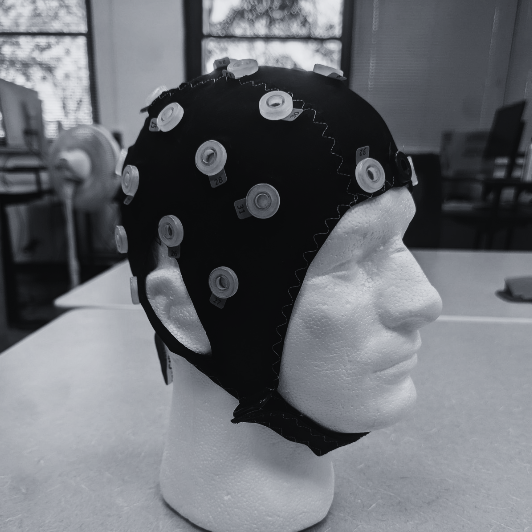
Recruited and scheduled participants, prepared EEG caps, monitored recording quality, and conducted experimental sessions.
Preprocessed EEG data using MATLAB and EEGLAB and analyzed behavioral performance in R.
Produced figures, interpreted preliminary findings, and presented the project at the Society for Music Perception and Cognition conference.
Methods
The project combined behavioral testing, frequency-modulated auditory stimulation, EEG recording, and statistical analysis to investigate selective attention.
Participants
Adult volunteers completed the study after providing informed consent. Participants were recruited, screened, scheduled, and guided through the experimental procedures.
Behavioral Task
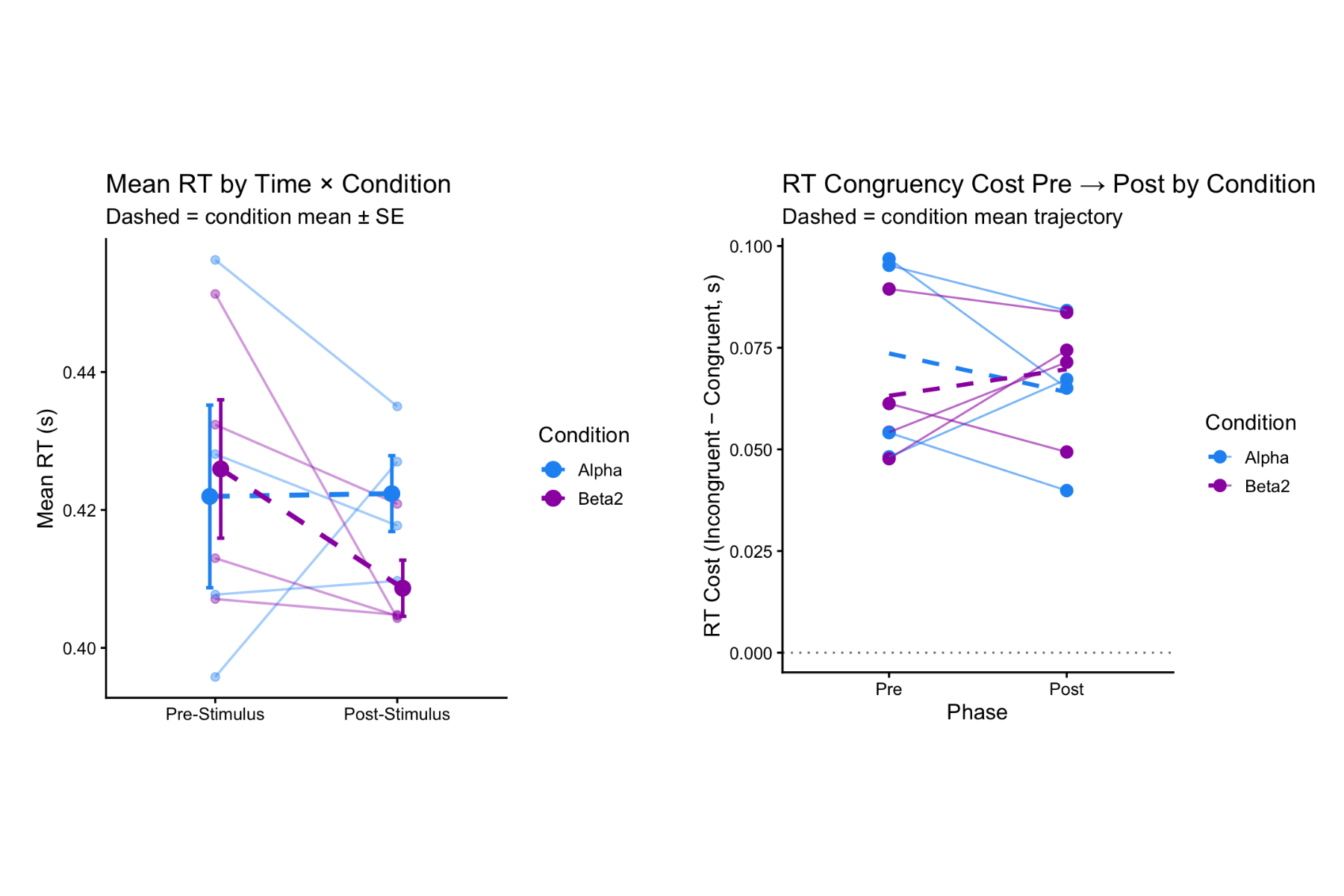
Participants completed a modified flanker task before and after auditory stimulation. Reaction time and accuracy were recorded to assess changes in selective attention.
Auditory Stimulation
Participants listened to frequency-modulated auditory stimuli designed to target alpha- or beta-range neural activity between the pre- and post-stimulation task blocks.
EEG Recording
EEG activity was recorded with a BrainVision system. Sessions included cap preparation, electrode setup, impedance checks, event synchronization, and troubleshooting.
EEG Preprocessing
EEG data were organized and preprocessed in MATLAB using EEGLAB, including inspection, filtering, event handling, artifact correction, and preparation for neural analyses.
Behavioral Analysis
Reaction time, accuracy, and congruency effects were analyzed in R using visualizations and statistical models comparing performance across time and stimulation conditions.
Results
Data collection is ongoing. These preliminary analyses summarize behavioral trends observed in the current participant sample (N = 8).
Tools
Research collaboration
Add a short invitation for research opportunities, collaboration, or discussion.